Please leave comments, contact directly via email hpoconnell@yahoo.ie or follow on Twitter @henrypoconnell

Friday, October 9, 2020

Cold War Basketball


Special thanks this week goes to Jerome Casey, my old friend and fellow enthusiast for all things sporty, who gave me the idea and source material for this blog by directing me to the events of the 1972 Munich Olympics.


1972 Olympics Men's Basketball final: USA versus USSR


The politicization of sport has probably been around for as long as organized sport itself. In earlier blogs I have referred to the strong political and military associations of the first ‘marathon’ https://sportyman2020.blogspot.com/2020/04/the-first-marathon-as-we-now-know-it.html, when Pheidippides ran to Athens to announce a great victory over the Persians, right through to the many ‘lost’ Olympic medals won by Irish athletes when competing for other nations, especially the United Kingdom and the United States https://sportyman2020.blogspot.com/2020/03/olympian-warfare-art-and-tipperary.html, along with the tragic events of almost exactly a century ago in Croke Park https://sportyman2020.blogspot.com/2020/03/bloody-sunday-1920.html


Matt McGrath (1876-1941), the Tipperary native who won three Olympic medals between 1908 and 1924 in the hammer throw, representing the United States. When the US team marched past the royal box at the 1908 London Olympics, legend has it that McGrath told the US flag bearer not to dip his flag (as was the custom) in acknowledgement of the king, leading to the phrase that 'this (American) flag dips to no earthly king'.


Michael Hogan (1896-1920), Tipperary footballer murdered by British forces while playing against Dublin in Croke Park on Bloody Sunday, November 21st 1920 and after whom the Hogan Stand is named.


Pheidippides (no Tipperary connection this time) announcing the 
Greek victory over the Persians in c. 490 BC (and subsequently dropping dead).


Cold War Sport

At no time in history was the politicization of sport so acute and intense as during the Cold War in the second half of the 20th Century and a few more Sportyman blogs relating to the early years and then the final years of that conflict highlight how sport can be so overshadowed by darker, political forces.

In the case of individuals such as Emil and Dana Zatopek, the beauty of sport was embodied not just in their individual triumphs but in their subsequent ability to make lifelong friendships that transcended the deep political and cultural divides of their day https://sportyman2020.blogspot.com/2020/03/emil-and-dana-olympian-love-affair.html and https://sportyman2020.blogspot.com/2020/03/emil-zatopek-and-pandemic-running.html. In the case of Eamonn Coughlan at the World Championships in 1983, the beauty of sport was embodied in showing how a plucky little island nation could take on the might of the Soviet Union and win https://sportyman2020.blogspot.com/2020/03/memories-of-helsinki.html


Emil and Dana Zatopek - an Olympian love affair


Eamonn Coughlan overtakes Soviet athlete Dmitriy Dmitriyez on his way to win 5,000m gold at the 1983 World Championships in Helsinki


And if the Cold War was the peak of sports politicization, then surely the 1972 Munich Olympics was the darkest episode of that peak. Along with the simmering and potentially catastrophic tensions between the United States and the USSR in 1972, Middle Eastern tensions also spilled over into the sporting domain, with eleven Israeli athletes kidnapped and murdered by Palestinian terrorists in Munich.

In sporting terms, however, events reached boiling point in Munich in the Men’s Basketball final, featuring the two key foes of the Cold War.

Being an American game, the Olympic gold medal in basketball was generally taken as an automatic entitlement for the American team and they had won all seven previous Olympic men’s finals in the sport, going back to 1936.


In the red corner: the USSR basketball team for the 1972 Olympics


And the Americans...


From the outset, however, this final was clearly not going to be a straightforward win for the United States. In fact, they trailed their Cold War foes for the entire duration of an ill-tempered game, right until the very end.

As my only real experience of basketball viewing was in recently watching the absorbing Michael Jordan Netflix documentary ‘The Last Dance’, I will not even try to describe the events of those last few seconds of play in the 1972 basketball final.


Michael Jordan's Netflix epic - an absorbing series, but pales in comparison to the story of 1972


So instead of me trying to describe it, just click on the link below and let the drama unfold all over again. 

And just make sure you watch it to the very end…


https://www.youtube.com/watch?v=CwTPG792LG8


Friday, October 2, 2020

Liverpool FC - the 1940s


In the Sportyman history of Liverpool Football Club, I jumped ahead last week to the 1950s in acknowledgement of that League Cup clash with Lincoln City.

So this week it’s back to the 1940s…

There were only four full seasons of regular football in this decade, with various regional war-time leagues played during World War II. Right full back Tom Cooper, who played 160 times for Liverpool and captained England on two occasions, lost his life during the war.

Most professional football players had signed up with the armed forces and were entitled to play with teams near their bases. During this time, over 80 players from different clubs played for Liverpool as ‘guests’. This arrangement threw up a few unique occurrences, not least Corporal Bill Shankly (a Preston North End player) playing once for Liverpool, when he helped them to a Liverpool Senior Cup final victory over Everton in 1942. Shankly was joined as a guest player on that team by Irishman and Manchester United player Johnny Carey, who scored Liverpool’s third goal in a 4-1 victory over Everton at Anfield – there’s a table quiz question in that one.


Bill Shankly (1913-1981) during his playing days 
with Preston North End


Johnny Carey (1919-1995) of Ireland and Manchester United, who scored for Liverpool (as a 'guest' player) in their 1942 Liverpool Senior Cup final victory over Everton at Anfield in 1942, with Bill Shankly also on that Liverpool team


As with the restart of football after World War I, https://sportyman2020.blogspot.com/2020/09/two-titles-two-irishmen-and-two-macs.html, Liverpool hit the ground running and won the first post war First Division title, in 1946-1947. Liverpool’s pre-season American tour was cited by manager George Kay as a factor in the 1946-1947 championship success. Conditions in America were a far cry from war rationed Britain and the Liverpool squad had access to delicacies such as American steak and orange juice. Over the course of the tour, the squad bulked up by an average of half a stone per man and Kay felt this was key in their subsequent success.

As in 1899, https://sportyman2020.blogspot.com/2020/05/aston-villa-5-liverpool-0-1899-and-2019.html, the 1946-1947 title fight went right down to the wire, with Liverpool again travelling to Birmingham for their final game. This time the opposition was Wolverhampton Wanderers. Unlike the 5-0 hammering at the hands of Aston Villa in 1899, Liverpool came away with a 2-1 victory, with Wolves having only needed a draw to secure the title for themselves.

Liverpool then had an anxious wait for two weeks until Stoke lost their last match of the season, thus surrendering their own title chances and confirming Liverpool as champions. The final league table shows the narrow margin of Liverpool’s victory, with only two points separating the top four teams and Liverpool jumping from fourth to top in the last two games. The league table stats also give an indication of the erratic nature of Liverpool’s season, losing ten and drawing seven of their 42 matches.


Liverpool FC for 1946-1947 (note the presence of two future managers standing in the back row - Phil Taylor and Bob Paisley)

Back row: Tom Bush, Phil Taylor, Jim Harley, Cyril Sidlow, Ray Lambert, Bob Paisley, Albert Shelley (Trainer).

Front row: William Watkinson, Willie Fagan, Albert Stubbins, Stan Palk, Billy Liddell, Laurie Hughes.


Final league standings for 1946-1947, demonstrating the tightness of that race


The decade ended with Liverpool reaching the FA Cup final in 1949-1950. This would be Liverpool’s first Wembley final, the 1914 FA Cup decider having been played at Crystal Palace, https://sportyman2020.blogspot.com/2020/08/liverpool-fc-third-decade-1910-1920.html. Despite now having won the league on five occasions, Liverpool had yet to win the FA Cup. A legend had already developed in the city that the two Liver Bird monuments on top of the Royal Liver Building in Liverpool would fly away before Liverpool won the FA Cup. Unfortunately, the Liver Birds were to continue flightless in 1950 and Liverpool’s FA Cup jinx was to continue, losing the final 2-0 to Arsenal. 


Liverpool's Royal Liver Building, with Liver Birds perched on top


https://www.youtube.com/watch?v=T6J9-14ZzAw


Video from the 1950 FA Cup final


With a league title and FA Cup final appearance in the space of four seasons, it would seem that Liverpool had reason to be hopeful heading into the 1950s. However, the reality was that they had an ageing team and, without any key replacements, the footballing decade ahead would prove to be Liverpool’s worst of all time.

Despite being only half a decade in footballing terms, Liverpool had good success in the 1940s and a few key figures from this period warrant special mention.


Billy Liddell – Liverpool’s third era defining player

I have already paid tribute to Billy Liddell in last week's blog but, such was his impact on Liverpool over a sustained period, he warrants inclusion again for the 1940s blog.

Liddell played exclusively with Liverpool for his entire professional career, stretching from before the World War II in July 1938 right through to those grim Second Division years of the 1950s and on to the beginning of the Shankly era in 1960. Matt Busby, one time Liverpool player and captain and subsequent quite successful manager of another club, is said to have tipped off Liverpool manager George Kay to Liddell, saying ‘this Liddell lad might be worth an enquiry’. As stipulated by his parents, Liddell was contractually allowed to complete his training as an accountant while playing with Liverpool, thus having another career to fall back on after football. In fact, he continued to work as an accountant throughout his Liverpool playing career.


Billy Liddell (1922-2001) and Liverpool forward from 1938-1961


Liddell was extremely strong, fast and versatile, playing as a left sided winger and centre forward and scoring 215 league goals in 492 matches. At the time of his retirement his 534 appearances was a club record for Liverpool, and he is currently 12th on that particular metric, and 4th on the all time top goalscorer table. In The Anatomy of Liverpool (Jonathan Wilson and Scott Murray) Liddell is highlighted as being one of five key era defining players for Liverpool, coming after Alex Raisbeck https://sportyman2020.blogspot.com/2020/08/liverpool-fc-second-decade-1900-1910.html and Elisha Scott https://sportyman2020.blogspot.com/2020/09/two-titles-two-irishmen-and-two-macs.html and before Kenny Dalglish and Steven Gerrard. Such was his importance to the club that Liverpool got the nickname of ‘Liddellpool’ during his career. Accounts of his contemporaries describe a quiet and religious man who did his talking on the pitch.

Although he had only a brief spell playing with Bill Shankly as Liverpool manager, Shankly was well aware of Liddell’s talents and importance to Liverpool, describing him as ‘fast, powerful, shot with either foot and his headers were like blasts from a gun. On top of all that he was as hard as granite. What a player! He was so strong – and he took a nineteen-inch collar shirt’. 


Some other 1940s heroes - Stubbins, Balmer and Kay

Albert Stubbins signed for Liverpool from Newcastle United in September 1946 for a then club record of 13,000 pounds and he was a key figure in the ensuing championship winning season, ending as joint top scorer with Jack Balmer, on 28 goals each. In all, Stubbins scored 83 times in his 178 games for Liverpool and went on to work as a sports journalist after his retirement from the game.


Albert Stubbins (1919-2002) a record signing for Liverpool, 

who played with the club from 1946-1953.


Stubbins scoring his legendary 'goal in the snow' at Anfield in the FA Cup 6th round 
against Birmingham City on March 1st 1947


Aside from his footballing heroics in 1946-1947 and subsequent seasons for Liverpool, Stubbins also has the honour of being the only footballer featured among the cast of stars on perhaps the most iconic music album cover of all time, from a certain Liverpool band. If you look closely at the image below you should just be able to make out his smiling face over the right shoulder of Marlene Dietrich.


That album cover...


And here's a closer look, revealing Albert Stubbins


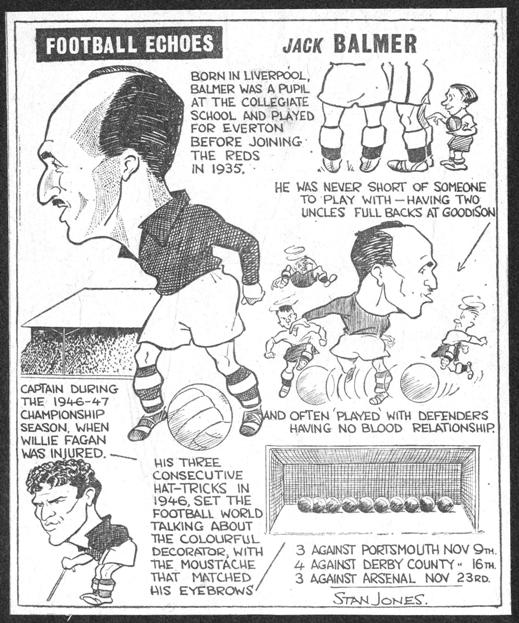
Jack Balmer 

Jack Balmer was the other scoring star for Liverpool during this period, racking up 110 goals in 309 appearances between 1935 and 1952. 


Jack Balmer (1916-1984)


And finally, George Kay deserves at least a brief mention. In the history of Liverpool FC, only eight managers (from a total of twenty two) have managed to lead the club to top flight league success and George Kay is among the lesser known of these. An intensely dedicated and hardworking manager, he served with Liverpool from 1936 to 1951.


George Kay (1891-1954), one of only eight managers to lead Liverpool to top flight league success


The highlight of Kay’s playing career was in captaining West Ham United in the first Wembley FA Cup final in 1923. With an official attendance of over 100,000 and unofficial estimates of nearer 300,000, the dangerously overcrowded match has come to be known as The White Horse Final, partly due to the heroics of a policeman on his white horse.  https://www.theyflysohigh.co.uk/white-horse-final/4594609368


Image from the 1923 FA Cup Final that would come to be known as 'The White Horse Final'


Liverpool FC in the 1940s in summary

1939-1945

Regular football suspended due to World War II.

Trophies won during this period: Liverpool Senior Cup (1942); Football League Northern Section, Second Period (1942-1943); Lancashire Cup (1944)

1945-46

Manager: George Kay

Captain: Willie Fagan

Football League North: 11th

FA Cup: 4th round (winners: Derby County, their 1st win)

Top scorer: Willie Fagan (3)


1946-1947

Manager: George Kay

Captain: Willie Fagan

Division 1: Winners (5th win)

FA Cup: semi-final (winners: Charlton Athletic, their 1st win)

Top scorers: Jack Balmer and Albert Stubbins with 28 goals each


1947-1948

Manager: George Kay

Captain: Jack Balmer

First Division: 11th (winners: Arsenal, their 6th win)

FA Cup: 4th round (winners: Manchester United, their 2nd win)

Top scorer: Albert Stubbins (26)


1948-1949

Manager: George Kay

Captain: Jack Balmer

First Division: 12th (winners: Portsmouth, their 1st win)

FA Cup: 5th round (winners: Wolverhampton Wanderers, their 3rd win)

Top scorer: Jack Balmer (16)


1949-1950

Manager: George Kay

Captain: Jack Balmer

First Division: 8th (winners: Portsmouth, their 2nd win)

FA Cup: beaten finalists (winners: Arsenal, their 3rd win)

Top scorer: Bill Liddell (19)


Wednesday, September 23, 2020

Lincoln City versus Liverpool: a 1950s traumatic flashback


Liverpool’s Carabao League Cup match away to Lincoln City tomorrow evening got me trawling through the history books for previous clashes between the clubs. And along the way I also stumbled across a few random points of Lincolnian interest.

Firstly, Lincoln biscuits (a 1980s childhood delicacy when served with butter and jam) are now apparently available only/mainly in Ireland, being made by Jacobs. Their actual connection with the city of Lincoln is unclear.


A Lincoln biscuit with its characteristic raised dots


And the distinctive packaging...


And speaking of tenuous links with Ireland, there is also the etymological connection between Lincoln and Dublin, both containing the old Celtic word for ‘pool’ (i.e. lin or linn), with Dublin being a black (Dubh) pool and Lincoln being simply ‘the’ pool. Incidentally, the origin of Liverpool’s name comes from a pool of thick or muddy water.

Also of historical interest and with another vaguely 1980s connection is the Gremlin like Lincoln Imp, a 'grotesque' that is to be found on Lincoln Cathedral and that somehow manages to make its way on to the crest of Lincoln City Football Club.


Lincoln Cathedral - with construction commencing in 1072, this was the world's tallest building for over two hundred years


The Lincoln Imp, to be found within Lincoln Cathedral and on the crest of Lincoln City Football Club


Lincoln City's grotesque home jersey for 2020-2021 


But back to football. Liverpool have played Lincoln City on 23 occasions in their history, including Liverpool's first ever Football League game at Anfield in 1893, when they beat Lincoln City 4-0. In total, Liverpool have won 13 of their matches against Lincoln City, drawing 5 and losing 5. Twenty of those encounters were league games, with three in the FA Cup. Of the league games, all were played in the Second Division, with six played in the first two decades of Liverpool’s history and the other 14 played between 1954 and 1960. This was the darkest footballing era for Liverpool FC, and worse even than the 1930s, also a trophy-less decade but at least First Division status was maintained throughout https://sportyman2020.blogspot.com/2020/09/liverpool-fc-in-1930s-great-footballing.html.

So, with no offence intended to Lincoln City, Liverpool returning there tomorrow night is likely to awaken dark and traumatic 1950s memories for any Liverpool fans old enough to remember when this was a regular Second Division fixture. 

For the three previous seasons when Liverpool had started in the Second Division (1893-1894, 1895-1896 and 1904-1905), they managed to win the division and obtain immediate promotion. But the 1950s was to be different. After being relegated in 1953-1954, Liverpool dropped to an 11th place finish in Division Two in 1954-1955 and at one time looked at risk of falling into the third tier of English football. At the risk of overdoing the linn-related references, the Second Division became a pool of quicksand for Liverpool for eight seasons. Incidentally, while Liverpool's footballing fortunes have improved beyond recognition from those 1950s lows, Lincoln City never made it out, dropping back further to their current status as a third tier, League One club. 

As you can see from the 1950s summary stats at the end of this blog, the ignominy of Second Division football for Liverpool for six seasons of the decade (and two seasons of the 1960s) was compounded by the concurrent successes of clubs that would become Liverpool’s greatest domestic and European rivals.  

So while Liverpool suffered relegation in 1953-1954 and a subsequent protracted battle to get back to the First Division, their (in recent decades at least) fiercest rivals Manchester United won the First Division three times in the decade (1951-1952, 1955-1956 and 1956-1957) thus catching up with Liverpool’s total of five top flight titles. To add insult to injury, United got to strut their stuff in the newly established European club competition, known then as the European Cup and known now as the UEFA Champions League.

United even managed two European Cup semi-final appearances in the late 1950s, but the competition was completely dominated by Real Madrid in those early years, with the Spaniards winning the first five consecutive titles, between 1955 and 1960.

And when Real Madrid took that fifth European title in 1960 they would have known little of the still sleeping giants then stuck in the English Second Division who would ultimately rise again and beat them in the 1981 European Cup final to win their own third European title.


Liverpool's ill fated 1953-1954 team - they would end the season 22nd and bottom of the First Division and thus relegated. Notable players include future managers Phil Taylor (standing on extreme left) and Bob Paisley (sitting on extreme right), along with Billy Liddell who is seated directly beside Paisley.  

Back row: Eddie Spicer, Charlie Ashcroft and Ray Lambert.

Middle row: Phil Taylor, Sammy Smith, Laurie Hughes, Louis Bimpson, Joseph Maloney, Roy Saunders, Alan A'Court

Front row: Jimmy Payne, Kevin Baron, Bill Jones, Billy Liddell and Bob Paisley


The 1950s: one Liverpool hero at least

Throughout those dark days of Second Division football, Liverpool had at least one stalwart player, who showed great loyalty in sticking with the club and who would go on to achieve legendary status.

Billy Liddell was a Scottish forward who played exclusively with Liverpool for his entire professional career, stretching from before World War II in July 1938 right through to those grim Second Division years of the 1950s and on to the very beginning of the Shankly era. During the 1950s, Liddell was top scorer for six seasons and captain for three of those. Matt Busby, one time Liverpool player and captain and subsequently quite successful manager of another club, is said to have tipped off Liverpool manager Gorge Kay to Liddell, saying ‘this Liddell lad might be worth an enquiry’. As stipulated by his parents, Liddell was contractually allowed to complete his training as an accountant while playing with Liverpool, thus having another career to fall back on after football. In fact, he continued to work as an accountant throughout his Liverpool playing career.


Billy Liddell (1922-2001) who played with Liverpool from 1938 to 1961


Liddell was extremely strong, fast and versatile, playing as a left sided winger and centre forward and scoring 215 league goals in 492 matches. At the time of his retirement his 534 appearances was a club record for Liverpool, and he is currently 12th on that particular metric, and 4th on the all time top goalscorer table. He also managed 29 caps for Scotland. Had it not been for the interruption of World War II, when he served in the Royal Air Force, Liddell’s stats could have been even more impressive.

In The Anatomy of Liverpool (Jonathan Wilson and Scott Murray) Liddell is highlighted as being one of five key era defining players for Liverpool, coming after Alex Raisbeck https://sportyman2020.blogspot.com/2020/08/liverpool-fc-third-decade-1910-1920.html and Elisha Scott https://sportyman2020.blogspot.com/2020/09/two-titles-two-irishmen-and-two-macs.html and before Kenny Dalglish and Steven Gerrard. Such was his importance to the club that Liverpool got the nickname of ‘Liddellpool’ during his career. Accounts of his contemporaries describe a quiet and religious man who did his talking on the pitch.

Although he had only a brief spell playing with Bill Shankly as Liverpool manager, Shankly was well aware of Liddell’s talents and importance to Liverpool, describing him as ‘fast, powerful, shot with either foot and his headers were like blasts from a gun. On top of all that he was as hard as granite. What a player! He was so strong – and he took a nineteen-inch collar shirt’. 

The darkest hour is just before the dawn

So Liverpool spent the second half of the 1950s getting close to but never quite making promotion back to the First Division.

A footballing nadir was reached in January 1959 when (with Billy Lidddell dropped for the game) Liverpool lost in the 3rd round of the FA Cup to Southern League team Worcester City, a defeat that may well have spurred the Liverpool board to look for a replacement for manager Phil Taylor.

The Liverpool board found their replacement later in 1959 when they lured a fast talking and ambitious but as yet unproven young manager from Huddersfield Town to Liverpool. Within a few years he would transform Liverpool Football Club and bring them back to the very top table of English and ultimately European football. 


The darkest hour is before dawn - Worcester City knock Liverpool 

out of the FA Cup in January 1959


A new dawn arrives - Bill Shankly signing as manager of Liverpool Football Club on December 1st 1959


Munich air disaster

Finally, the 1950s football related tribulations for Liverpool paled in comparison to the tragedy for Manchester United of the Munich Air Disaster in February 1958. Former Liverpool player and captain Matt Busby had assembled an extraordinarily talented young team who had come to be known as the Busby Babes, winning consecutive First Division titles and performing well in Europe. Eight of the team (along with fifteen others) were killed as a result of the crash, including 22 year old Irishman Liam Whelan. Among the survivors were Bobby Charlton and Matt Busby himself. 


Liverpool FC in the 1950s: summary of a decade of footballing darkness

(Top scorer is based on combined league and FA Cup goals)


1950-1951

Manager: George Kay

Captain: Phil Taylor

League: 9th in Division 1 (winners: Tottenham Hostpur, their 1st win)

FA Cup: 3rd round (winners Newcastle United, their 4th win)

Top scorer: Billy Liddell (15)


1951-1952

Manager: George Kay, succeeded by Don Welsh

Captain: Phil Taylor

League: 11th in Division 1 (winners: Manchester United, their 3rd win)

FA Cup: 5th round (winners: Newcastle United, their 5th win)

Top scorer: Billy Liddell (19)


1952-1953

Manager: Don Welsh

Captain: Phil Taylor

League: 17th in Division 1 (winners: Arsenal, a record 7th win)

FA Cup: 3rd round (winners: Blackpool, their first win)

Top scorer: Billy Liddell (13)


1953-1954

Manager: Don Welsh

Captain: Bill Jones

League: 22nd in Division 1 and relegated (winners: Wolverhampton Wanderers, their first win)

FA Cup: 3rd round (winners: West Bromwich Albion, their 4th win)

Top scorer: Sammy Smyth (13)


1954-1955

Manager: Don Welsh

Captain: Laurie Hughes

League: 11th in Division 2 (winners of Second Division: Birmingham City. Chelsea won the First Division for the first time)

FA Cup: 5th round (winners: Newcastle United, for a record 6th time)

Top scorer: John Evans (33)


1955-1956

Manager: Don Welsh

Captain: Billy Liddell

League: 3rd in Division 2 (winners of Second Division: Sheffield Wednesday. Manchester United won the First Division for the 4th time)

FA Cup: 5th round (winners: Manchester City, their 3rd win)

Top scorer: Billy Liddell (32)

European Cup: first championship and won by Real Madrid with Hibernian of Scotland the only British representatives, reaching the semi-finals.


1956-1957

Manager: Phil Taylor

Captain: Billy Liddell

League: 3rd in Division 2 (winners of Division 2: Leicester City. Manchester United won First Division for the 5th time).

FA Cup: 3rd round (winners: Aston Villa, their 7th win)

Top scorer: Billy Liddell (21)

European Cup: the second year of the competition and again won by Real Madrid, with Manchester United reaching the semi-finals


1957-1958

Manager: Phil Taylor

Captain: Billy Liddell

League: 4th in Division 2 (West Ham United won Division 2, with Wolves winning the First Division for the 2nd time)

FA Cup: Quarter final (winners: Bolton Wanderers, their 4th win)

Top scorer: Billy Liddell (23)

European Cup: the third year of the competition and again won by Real Madrid, with Manchester United again reaching the semi-finals


1958-1959

Manager: Phil Taylor

Captain: Johnny Wheeler

League: 4th in Division 2 (winners: Sheffield Wednesday, Wolves won the First Division for the second time).

FA Cup: 3rd round (winners: Nottingham Forest, their 2nd win)

Top scorer: Jimmy Melia (21)

European Cup: Real Madrid continue their complete dominance of the competition with their 4th win. Wolves exited after the first round.


1959-1960

Manager: Phil Taylor, succeeded by Bill Shankly

Captain: Ronnie Moran

League: 3rd in Division 2 (winners: Aston Villa. Burnley won the First Division for the second time)

FA Cup: 4th round (winners: Wolverhampton Wanderers, their 4th win)

Top scorer: Roger Hunt (23)

European Cup: Real Madrid remained the only winners to date, with their 5th consecutive win. Wolves reached the quarter finals