Please leave comments, contact directly via email hpoconnell@yahoo.ie or follow on Twitter @henrypoconnell

Sunday, June 7, 2020

Mixed Martial Arts - Origins


I am thrilled to be able to welcome Dr. Kevin Lally as a guest blogger with Sportyman2020 for the next three weeks. Along with being one of Ireland's brightest young Psychiatrists, Kevin has multiple interests and a varied background outside of his medical career, including boxing, bee-keeping, computer programming and, luckily for Sportyman2020, Mixed Martial Arts (MMA) and writing. 

I've always found MMA to be a bit mysterious but I've learned a huge amount from reading Kevin's very lively pieces. In this first installment, Kevin takes us on a fascinating journey through the history of MMA, with origins traceable to wrestling competitions in Ancient Greece right through to martial arts developments in Japan, street fighting in Brazil and most recently the Ultimate Fighting Championship (UFC) in the United States. Next week, Kevin will write about MMA in Ireland, 'a tale of tragedy and triumph' and how, in Kevin's words, 'an island of scrappers produced the world's biggest MMA star'. For the third installment, Kevin will cover the controversial area of safety issues relating to MMA. 

So whether you're already an MMA fan or the whole area is new to you, you will really enjoy this MMA trilogy...

Oh and you can follow Kevin on Twitter: @kevinly


Introducing MMA

Mixed martial arts (MMA) is for some a sport and for others a vulgar form of entertainment. Modern MMA can reliably trace its origins to the early 1990s with the start of the Ultimate Fighting Championship (UFC) and its connections with the infamous Gracie family which we will discuss later.

The growth of MMA has been expansive both in terms of participation as a sport and in terms of audience for entertainment. Ireland has a had a colourful relationship with MMA since the near beginning but only came to a mainstream audience during the Conor McGregor era.

The history and culture of martial and military arts – fighting – either with or without weapons is rich and diverse. Magazine and internet articles are full of amateur historians romantically describing the discovery, development and demise of various forms. Myth and legend, folklore and oral history are deeply intertwined.


Evolutionary origins

From an evolutionary perspective competition within a species for territory, mates and resources has given rise to sexual dimorphism. In vertebrate animals, males are often on average larger than females and adapted for fighting – antlers, horns, larger muscle mass, etc.

Thus we can surmise that men have been punching each other as long as they have possessed arms to do so. Similarly, wrestling has been a method to settle squabbles between rivals since the dawn of time. In fact, wrestling as a form of solving rivalry disputes and other acts of dominance is well recorded in the animal kingdom – a brief collation is described here https://www.youtube.com/watch?v=fdNuFgsobDY here https://www.youtube.com/watch?v=hBtLNK5GPYc and here https://www.youtube.com/watch?v=OyrloQ8ijLA

This is not meant as a sexist statement, the historical record is reasonably consistent in reporting that wars were mostly fought between armies made of male recruits. The animal kingdom is equally consistent in showing that males are more likely to be the aggressive sex especially amongst large vertebrate animals like mammals, reptiles and birds. However, when it comes to history, we must acknowledge that so much is biased by the male gaze and secondly consider the male composition of armies is more likely a social construct rather than a biological inevitability.


A Brief History of MMA

While fighting between species or amongst species is ubiquitous we can narrow down the definition of MMA to

a contest between two opponents based on a variety of skills –including both striking and wrestling techniques

and focus our attention on three major episodes:

·         Pankration and the Ancient Greeks

·         Vale Tudo in Brazil in the 20th century

·         UFC in California in 1993


Pankration

Some solid evidence that these two forms of fighting were combined and used in a formal contest comes from pottery and other art work from Ancient Greece.


This vase has been decorated with a fight scene dated to 330 BC (Wikipedia).


This is a statue called The Pancrastinae which is a replica of the original which describes a grapple sequence in a Pankration bout.


This type of fighting is called Pankration and was an event in the original Olympics. Plato in his dialogue Laws describes tactics for being successful in Pankration (circa 350 BC).

Modern MMA probably looked a lot like ancient Pankration. The exact rule set was probably fluid and varied from region to region, while punching, kicking, joint locks and strangle holds were core, attacks like headbutts, eye gorging and biting seem more variable. Pankration was not included in the rebirth of the Olympic Games in 1896.

This is interesting as this shows that MMA style fighting has been around for millennia but also how matters of taste influence the development of a sport. We can speculate that Pankration was split back into the arguably the more entertaining boxing and again arguably the more sporting contest of wrestling to pander to audience preference.


Vale Tudo

The pursuit of expertise in unarmed combat is a strange interest. It takes a moment’s reflection to observe that the most Herculean brute armed with a sublime knowledge of martial arts is no match for a group of unremarkable people with heavy sticks. The development of weaponry for hunting of animals as well as, we must face it, the killing or subduing of people has trumped self-defence. Sticks, poles, knives, swords and subsequently guns have made the art of unarmed combat practically redundant. Despite what you might hear about the fighting prowess of ex-Navy Seals (e.g. Close-quarters defence), Russian special forces (e.g. Systema) or the Israeli army (Krav Maga) there is no evidence these training systems have any proven benefit in real world situations.

However, in the late 18th and early 19th century there were a series of serendipitous circumstances that allowed the development of sophisticated unarmed combat. In Japan, there was a wealth of experience in the martial art called Jiu-jitsu (various spellings include Jujitsu etc.). This would later be refined by a Japanese Educator named Jigaro Kano (Kanō Jigorō 1860-1938) into the modern sport we know as Judo. Kano, a man of diminutive size (5’2”, 90lbs) had adapted the techniques of Jiujitsu into those that were both effective and those that could be readily trained without risk of serious injury. In essence he removed techniques relating to striking or weapon use and refined the rest from the perspective of a smaller person for self-defence and exercise purposes.


Jigaro Kano 1937 soruce: http://www.gettyimages.co.uk/search/2/image?phrase=Jigoro%20Kano%20asahi&family=editorial&sort=best&editorialproducts=&excludenudity=true&page=1


An exemplary student of Kano, Mitsuyo Maeda (1878  –1941) had travelled the world, from Europe, to the United States, through Central America down to Brazil. He had been competing in various challenge and prize fighting bouts at circuses and theatres around the world. Some were exhibitions and others were true contests.  In Brazil, this type of entertainment was called Vale Tudo (everything goes). He performed in a circus owned by a member of the Gracie family. Carlos Gracie (1902-1994) was in the audience and was mesmerized by the techniques. Carlos went on to learn the art from Maeda and later opened a school in Rio de Janeiro.

An interesting observation is that the culture of “street fighting” in parts of Brazil at this time were conducted under “gentleman’s rules”. That is to say, if there was a disagreement and an invitation to fight was offered, it was almost universally agreed upon that outside parties would not intervene. It is hard to prove that such a culture actually existed as it does romantically mimic the duels between 17th century aristocrats but nevertheless it must be considered. An entirely essential ingredient for the development of unarmed fighting was the principle that when you turned your back, or went to the ground to engage grappling techniques, your foe's mates don’t rush up behind you and kick you to death. This is no longer a presumption you can make.

Over the next thirty or so years the Jiu-jitsu practiced in Brazil diverged from that taught in Japan. Judo was introduced into the modern Olympics in the 1964 Tokyo Games. Judo rules became more consistent with national organisations responsible. However, in Brazil, the Gracie family (and others) continued to refine the martial art through challenge matches and other competitions with broader rule sets. The Gracie Jiu-jitsu developed rivalries with practitioners of different martial arts – Capoeira, Luta livre and catch-wrestling. They often pitted themselves against each under the moniker of Vale tudo competition.


UFC

While Vale Tudo was popular in Brazil especially in Rio de Janeiro it was essentially an underground movement. Professional wrestling where the bouts were largely choregraphed and designed to be a better spectacle was more commercially successful. Rorion Gracie (1952-date), nephew of Carlos Gracie and a Brazilian Jiujitsu expert emigrated to the United States. His goal was to spread the word of his family’s martial art. While working in Hollywood as a stuntman he taught Jiu-jitsu in his garage to his Hollywood friends and colleagues.

In 1993 Rorion Gracie and a businessman called Art Davie staged the first Ultimate Fighting Championship (UFC) event in Denver, Colorado. They sold the event on cable television pay-per-view (PPV) and it was quite profitable. They advertised the show as a competition between different martial artists e.g. Who would win between a boxer and a wrestler? The eventual winner of the 8-man tournament was Royce Gracie (1969-date), Rorion’s younger brother. Rorion and his advisers had deliberately chosen the least imposing member of the Gracie family to represent their art. Their vision was to wow the audience by presenting an unremarkable thin man, subduing a host of imposing and scary looking men.


The UFC was eventually sold to the Zuffa entertainment group in 2001. Dana White (1969-date), a Las Vegas based boxing promotor had taken over managing some of the UFCs early stars and saw huge potential to develop the company. He sought the backing of two childhood friends of his, the Ferrita brothers who had made a fortune in Casinos in Las Vegas. Zuffa assumed control of the UFC brand in 2001 and later acquired the equivalent brand in the Japanese market (Pride Fighting Championships) in 2007 becoming the undisputed international market leader in the sport of MMA.

In summary, MMA as a sport has its origins in the circus acts of various martial artists around the world. In this environment of survival of the fittest there was an unlikely winner in the form of Brazilian Jiu-jitsu which in turn allowed itself to become a cornerstone of the modern MMA movement. 

Blog post number two will address the development of MMA in Ireland and how an island of scrappers produced the world’s biggest MMA star.


Sunday, May 31, 2020

Three May Babies - and their sporting soundtracks


In non-pandemic times, May is always a very special sporting month. The English and European football seasons come to a conclusion, with the Premier League, FA Cup and Champions League all finally decided. For a small number of supporters, this means smug bragging rights for the summer and for the vast majority it means a few months to forget the disappointments of the season gone by and to fantasize that the season ahead will be the one to make everything right. And while football is winding down in May, the GAA inter-county championships in Hurling and Gaelic Football are just heating up, with supporters of counties in both codes briefly full of irrational expectations that this summer will be theirs.

Far more important than the sporting ecstasy of the month, our three children were all born in May, each three years apart. 

And for each of their arrivals, there is a unique sporting background soundtrack.

Our first baby related sporting soundtrack was the absolute pinnacle of Liverpool ecstasy when, less than three weeks after bringing home our firstborn in 2005, I watched the miracle of Istanbul on a small television in our first (very small) house in Dublin, where we were living at the time. I can’t add much quality to the countless words that have been written about that match except to add my one baby related incident. When Vladimír Šmicer scored Liverpool’s second comeback goal and that strangely ecstatic feeling descended on me that we were going to win, I jumped up and screamed. The Blonde was sitting on the couch beside me, holding our new bundle of joy, who promptly and perfectly understandably burst into tears and started her own screaming. The ladies excused themselves and I watched the footballing miracle unfold alone, through to the climactic penalty shootout.


Vladimír Šmicer scores - May 25th 2005, 56 minutes into the Champions League final and the precise moment I made my daughter cry 


Liverpool - European Champions for 2004-2005


The second baby related sporting soundtrack comes from almost exactly three years after the first, and this was not such a happy one. As The Blonde started to feel the first pangs of labour, we checked in to the hospital and I remember mixed up in all the tension and excitement of the evening that my phone was lighting up with text updates from various friends regarding the Champions League Semi-Final between Liverpool and Chelsea. In the end, our second daughter hung on to maintain the family 'May baby' tradition and waited until the following day, May 1st, for her arrival. Chelsea won the tie 4-3 on aggregate. To add insult to injury, they lost the subsequent Champions League Final to, of all teams, Manchester United. 


Champions League semi-final second leg, April 30th 2008: Fernando Torres with Liverpool's equalizer that would take this humdinger of a game to extra time


And then three years later again, towards the end of May, our son arrived. Of the three, he had the most remarkable backing sporting soundtrack. The weekend of his birth featured three matches in different codes where my team came out on top each time. Sporty types will tell you that such weekends (when all your teams win) are rare and special. As The Blonde entered the agony of labour again, we had the distraction of the Celtic League Final in rugby, which we watched on the television in her hospital bedroom. Munster beat Leinster in a match that was taking place less than a mile away in Thomond Park. Neither of us are big fans of rugby but it's always nice to see Munster beat Leinster. 


Munster: Celtic League Champions for 2011, after beating 
arch-rivals Leinster in the final


A few hours passed and, being quite useless and getting in the way, one of the Midwives kindly suggested that I leave the Labour Ward for an hour or two and get some food. So while The Blonde's agony went on, I leisurely consumed a bag of chips and a fish burger in the nearby Supermacs while watching on their television as Barcelona beat Manchester United in the Champions League Final. As a Liverpool fan, a defeat for Manchester United is almost as good as a win for Liverpool. And our son timed his arrival to perfection. As Eric Abidal (who only a few months beforehand had had major surgery to remove a liver tumour) raised the cup for Barcelona, my mobile rang and the Midwife told me to return quickly because 'things are happening'. 


Lionel Messi performing his usual wizardry in the Champions League Final, May 28th 2011 - someone born that night would grow up to idolize him


Eric Abidal lifting the Champions League trophy for Barcelona, May 28th 2011 - the precise moment when our son announced his imminent arrival 


And then to top it all off, Tipperary played Cork the following day in the Munster Hurling Championship. Never ones for hanging around hospitals too long, we asked to leave early with the little man, safe in the knowledge that we were now seasoned parents of three and able to cope with any eventuality. I watched the hurling on the television in our hospital bedroom while waiting to get our discharge papers. And just as we left that room, with the new baby all wrapped up and bags packed, Benny Dunne rattled in Tipperary’s third goal of the afternoon to seal a very pleasing win.


May 29th 2011: Benny Dunne scores Tipperary's third goal in a comprehensive win over Cork in the Munster Hurling championship, and it's time to take the baby home


Sunday, May 24, 2020

'Gascoigne' - my review of a disappointing documentary


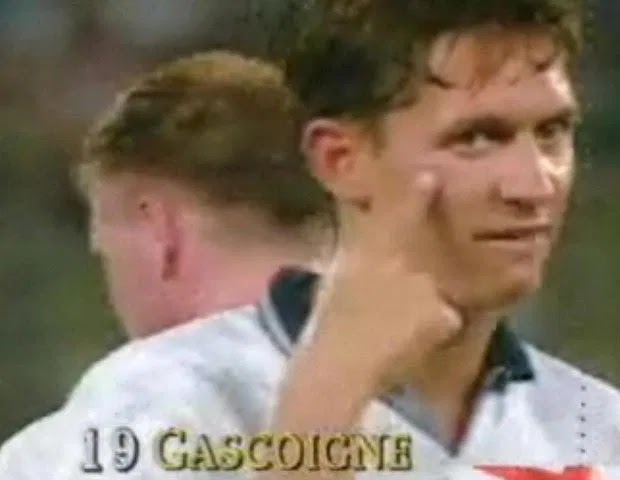
Jane Preston’s 2015 documentary on Paul Gascoigne clearly demonstrates one thing at least - the grim reality behind the epigram of that Greek philosopher Heraclitus, on your character being your destiny. So in contrast to the clean-cut, eloquent and always impeccably behaved Gary Lineker, who was famously never booked in his playing career and who went on to carve out a successful broadcasting career after hanging up his football boots, Paul Gascoigne’s playing career was marked by a few heady highs that demonstrated extraordinary levels of footballing potential and then lots of lows, many of them self-inflicted, both on and off the field.


Heraclitus (535 - 475 BC), Greek philosopher and a man who predicted a challenging life for Paul Gascoigne, two and a half millennia before he was even born


Most of Preston's documentary is based on a lengthy interview with Gascoigne himself, with some very supportive pro-Gascoigne opinions and soundbites thrown in by Jose Mourinho, Wayne Rooney and, most of all, by the ever polite and genial Gary Lineker.

As someone who never supported any of the teams that Gascoigne played for, my knowledge of and interest in him during his playing career in the 1980s and 1990s was somewhat limited and probably dominated by his reputation for partying and play acting. So I went to this documentary (partly driven by the COVID-19 lack of sport spectating options) to see what the story really was with Gascoigne. 

Unfortunately, Preston’s documentary provides very little new or revealing information on Gascoigne. And instead of a balanced and in depth analysis, we get a superficially polished hagiography. In fact, the almost condescending levels of kindness to Gascoigne combined with the willful blindness to his many deeply frustrating faults and failings means that this documentary ultimately does Gascoigne a disservice.

So even though I could never claim to have had a great knowledge of Gascoigne’s playing career or personal life, I learned very little new information from this documentary and instead came away with a sense that it was some kind of propaganda piece designed to help restore his image and rose-tint the memories of this once ‘national treasure’ (yes: that awful term is used to describe him at one stage in this documentary).


Gascoigne's footballing story (and a little bit about his life)

The documentary takes us on a chronologically straightforward biographical journey from Gascoigne’s childhood, growing up in late 1960s and 1970s poverty in Gateshead, just a few miles from Newcastle United’s home ground of St. James’s Park and from where he could hear the crowds cheering in the Gallowgate End on a Saturday afternoon, through to his early footballing years with Redheugh Boys Club and then on to his signing with Newcastle United at the age of sixteen. We get a few insights into those early years, but nothing earth shattering. He played football in the streets with friends and sometimes on his own, starting with a tennis ball until his father bought him his first leather football at the age of seven. There is no doubt that he loved football and he was not easily parted from that leather ball. 


A boyish Gascoigne 


Apart from the standard 'jumpers for goalposts' stories, Gascoigne also recounts a terrible early tragedy during this time, when the younger brother of a friend of his was hit by a car and killed. Gascoigne was ten at the time and the accident happened after they had run out of a shop. Gascoigne felt awful guilt as a result and he recalled that after the funeral he spent three days in the room where the boy’s coffin had been kept, before going on to develop what sound like involuntary tics and facial grimaces, possibly as a psychological reaction to the trauma. He had some brief psychiatric input at that stage.  

His apprenticeship years with Newcastle United were happy and productive, but he was already getting some attention for being a somewhat unconventional athlete, being described by one commentator as looking like ‘he plays for your local Sunday pub team…wearing T-shirt, anorak, jeans…and a diet of Mars bars and brown ale’. He had tough treatment from hard managerial men such as Arthur Cox and Jack Charlton, but nothing out of the ordinary for the times. And he seemed to enjoy every minute of this phase of his career. 


With Joe Allon and the 1985 FA Youth Cup in his early days at Newcastle United


Clips from those early days show a strong and agile player. He used his upper body strength and arms to 'protect' himself and through his football he seemed to enjoy expressing his own personality and style, in a way that was and still is quite unusual for English footballers. There was ‘a lack of fear in his game’ and he was undoubtedly a show off, as are so are many great players in their early days at least.  

There’s a brief review of his clash with Vinnie Jones of Wimbledon in 1988 which began with Jones screaming at Gascoigne in the tunnel at the start of the match: ‘Me and you, fat boy: I can’t play football and neither can you today’. The clash of Gascoigne’s skill against the brute bullying force of Jones culminated in one of the most infamous football images of all time. 


Vinnie Jones 'marking' Gascoigne, Plough Lane, 1988


Jones and Gascoigne doing a reenactment of the 1988 incident


Soon after this, Gascoigne was off to Spurs, after turning down the (as yet relatively unsuccessful) Alex Ferguson of Manchester United. It seems that Gascoigne was swayed in his decision by Spurs’ promise of a house and car for his parents and a sun-bed for one of his sisters. In an act of typical Fergusonian bitterness, he refused to talk to Gascoigne for six years after the rejection. But we are left to wonder if Gascoigne might have prospered professionally and personally had he gone to work under the grumpy disciplinarian at Manchester United as opposed to the comparably warmer and cosier character of Terry Venables at Spurs. It would have been a useful question to put to Gascoigne in this documentary.

His years at Spurs were marked by some of his greatest achievements and some of his biggest mistakes. During this time, he got his start for England, reaching the semi-final stage of the World Cup in Italy in 1990, England's loftiest level of progression since 1966. In the semi-final, he picked up his second yellow card of the tournament, for a rash challenge on the German Thomas Berthold, thus famously crying copious amounts during and directly after the match, realizing that he would be unable to play in the World Cup Final should England advance. Whether it was genuine puzzlement or a faux innocence, Gascoigne professed not being able to understand Berthold's writhing and screaming after he had fouled him, saying that ‘When I get kicked I take it as a compliment’, thus implying that he should perhaps have been thanked by the German for administering such a crushing tribute.

It was decided by England manager Bobby Robson and Gascoigne that he ‘didn’t feel right to take a penalty’ in the ensuing shootout at the end of that German semi-final, and England lost 4-3, thus starting a long sequence of penalty shoot-out heart-breaks that only came to an end at the 2018 World Cup against Columbia. Gary Lineker, in reflecting on Gascoigne’s non-participation in the 1990 shoot-out says he ‘wishes he had’ taken a penalty and again one wonders what other teammates would have thought of Gascoigne’s overwhelming self-pity and tears on the day and his lack of participation in the shootout.


Tears in Turin - World Cup 1990


Back in England, he won a much coveted (at that time at least) FA Cup winner’s medal with Spurs in 1991, after knocking out arch rivals Arsenal in the semi-final and scoring a 30 yard pile-driver free kick in the process. This was one of his most special footballing moments so it warrants a video link:


Thwack!


A brief clip from a post-match interview, with Gascoigne's adrenaline still in full flow, shows him at his very boyish best, when he tells a reporter: ‘I’m now away to get my suit measured’ (for the FA Cup Final).  

And then things took a turn for the worst. Despite helping Spurs to that 1991 FA Cup Final with his wonderful free kick, he was stretchered off early in the first half because of a wild kick/tackle on Gary Charles of Nottingham Forest that resulted in Gascoigne rupturing the cruciate ligament of his right knee and putting himself out of the game for eight months, thus delaying his planned transfer to Italian club Lazio in the summer. His Spurs teammates brought the FA Cup to him in is hospital bed. 

There are three interesting snippets from this documentary, new to me, that come from these two years. The first is purely footballing. As Gascoigne placed the ball on the ground for that FA Cup semi-final free kick against Arsenal, Gary Lineker ran purposefully towards him and said ‘Have a go’. Gascoigne may already have had the idea in mind or he may have taken Lineker’s advice. Either way, the ball ended up in the top corner of the Arsenal goal, and it serves as a perfect example of his fleeting brilliance and perhaps too the wisdom of the technically less gifted Lineker.

A year earlier, Lineker also imparted some advice to Gascoigne that was (to Gascoigne at the time at least) somewhat obtuse and lost on him. As the England team plane arrived home after their World Cup journey in Italy, Lineker said to him, sensing the media frenzy and hype that was about to envelop Gascoigne: ‘Paul – be careful’.

The third interesting snippet is from soon after arriving back from that World Cup when Gascoigne was interviewed on television by Limerick’s own Terry Wogan. Wogan outlined in his usual avuncular tone to a grinning Gascoigne how he was living every young man’s dream right now but, with a cautionary tone, he added prohpetically that ‘it could turn out to be a nightmare’.

As with the turning down of Manchester United, one has to wonder if Gascoigne might have had an easier journey had he listened more carefully to both Lineker and Wogan.


Gary Lineker notices Gascoigne's tears in Turin. Gascoigne's Spurs and England teammate always seemed to have an inkling as to his vulnerability


Terry Wogan demonstrated Heraclitean levels of wisdom 
when he hinted at potential for a future 'nightmare' for Gascoigne


Dotted in among the football sequences are brief examples of Gascoigne’s playfulness that sometimes went a little over the top, e.g his taking an ostrich to a training session to shock his team-mates or his asking Princess Diana for a kiss as she met the teams before the FA Cup final and, when she shyly refused, cheekily kissing her hand.


Stealing a kiss from Princess Diana at the FA Cup Final, 1991


After Spurs and recovering from his cruciate injury, Gascoigne went on to play for Lazio in the then furnace of Italian football, scoring a rare headed goal in front of 105,000 spectators in the Rome derby against Roma. At Lazio he sustained another significant knee injury, this time in training and resulting again in a further sustained period out of the game.

Gascoigne then left Lazio in a club record (4.3 million pounds) signing for Glasgow Rangers and enjoyed his most successful time as a player, in terms of silverware at least, winning two league titles, a Scottish Cup and League Cup. It was also during this period that he scored his most famous goal for England, against Scotland in the Euro 96 championships. The goal itself was sublime in its execution, so I have included a video link below. It was also tinged with extra significance because he was earning his living in Scotland at the time.


Gascoigne fires home against Scotland at Euro '96


And the famous 'dentist's chair' celebration after the goal


And here's a video link to the goal - well worth a watch

https://www.youtube.com/watch?v=evnXFu744uY


The ‘dentist’s chair’ celebration after that genius goal tells the other side of Gascoigne. The celebration was Gascoigne's and the England team’s way of having a go back at the media, who had outed their partying before the championships, with Gascoigne and other team members being administered shots in a bar while lying back in a 'dentist’s chair'.

Another standout moment during the Rangers years was his goal celebration where he mimicked playing a flute (as in an Orange parade), thus attracting the ire of an Irish republican who sent him death threats that were verified by the police as being serious and which were not lifted for six months. Gascoigne’s poor judgement for this choice of goal celebration was only compounded by his apparent disbelief that it could have caused offense.

After Rangers, he had brief spells with Middlesbrough, Everton, Burnley, Chinese club Gansu Tianma and Boston United, before retiring in 2004. 


The documentary - not enough warts

This documentary is either very sparing or completely lacking on some key issues. Gascoigne’s alcohol and drug use is mentioned almost in passing and in a ‘nod and wink’, ‘boys will be boys’ kind of way. There is absolutely no mention of Gascoigne’s relationships, his marriage or his daughter. And although he frequently hit the headlines in the 1990s as Gascoigne’s partying sidekick, there is no mention of Jimmy 'Five Bellies' Gardner. Very little is revealed in terms of Gascoigne's family of origin, apart from early allusions to poverty and, much later, his sister ‘sectioning’ him to a psychiatric hospital because of increasing paranoia and chaotic behaviour. He mentions being ‘close to death’ on two occasions but, frustratingly, no further detail is elicited or provided.

And then it all ends up rather neatly. Gascoigne’s paranoia (most probably not helped by prolonged and heavy alcohol and drug use) is almost excused as being reasonable and vindicated because of the hacking of his phone by journalists for 11 years up to 2005. At best, this is an oversimplification of those years of his life, although he was undoubtedly treated very badly by certain journalists.

To add to the frustration of watching this documentary, the contributions of Jose Mourinho and Wayne Rooney are trite, glib and delivered with a lack of real conviction. Rooney in particular is underwhelming in his comments. His main contribution is to say, at least three or four times, that Gascoigne was ‘the greatest player that England ever had’. The irony is that, even just among the three England players featured in this documentary, Gascoigne's contribution to his country comes in a distant third. And regarding the performance statistics for his particular position, he is not even close to being England's best midfielder, let alone 'the greatest player that England ever had'. The average England caps of Bobby Charlton, Steven Gerrard, Frank Lampard and Paul Scholes are 98 and their England goals average is 28. Gascoigne's England caps are 57, with just 10 goals. No amount of cheeky smiles and fancy turns can cover up these stats and one has to wonder if Wayne Rooney was having an off day in terms of his knowledge of English football history when this documentary was being made. 

Despite the obvious shortcomings of the documentary, however, there is no doubt that Gascoigne's likeability and boyish innocence comes shining through. 

And although too few in retrospect, his most memorable exploits on the football field mean that he is destined to go down as one who could have been one of England's greats.


Saturday, May 16, 2020

Physics, football and the Bundesliga


Some physics

So as part of my COVID-19 reading, I got around to having another go at Carlo Rovelli’s deceptively simple looking and brief book called ‘Seven Brief Lessons on Physics’. Written in elegant prose and conveying complex ideas about physics and the universe, I still don’t understand half of it. However, I can now casually drop into conversation direct quotes from Rovelli that, if chosen at the right time, can prove to be killer lines with jaw dropping levels of profundity, e.g. ‘The difference between past and future only exists when there is heat’ or ‘What is the present? In physics there is nothing that corresponds to the notion of the now’.


Rovelli's mind bending book - don't be deceived by the elegant and accessible writing style and the manageable looking 94 pages


And any guilt or shame I have at my lack of understanding many of the concepts in Rovelli’s book is easily assuaged by that old (mind boggling) maxim: ‘If you think you understand quantum mechanics, you don’t understand quantum mechanics’. Ultimately, my understanding of physics is limited to witty one liners from Sheldon and his friends on ‘The Big Bang Theory’, one of our primary family COVID-19 television viewing interests.


The Big Bang Theory - funny physics that I can (mostly) understand


Physics, football and a fling with the Bundesliga

Another mind bending notion covered by Rovelli is that of multiple alternative existences or universes, i.e. the multiverse. And, strangely enough, this got me thinking of football. Because while we have all been pining for a return of Premier League football since that abrupt cessation in early March (with Liverpool on the cusp of glory), domestic seasons have been ploughing on in some parallel footballing universes, such as Belarus and Nicaragua. Likewise, football has recently restarted in South Korea and the Faroe Islands. Most significantly of all, however, is the return today of the mighty German Bundesliga, albeit with no fans attending and played 'behind closed doors'. 


A vaguely 'multiversal' image


So while Project Restart continues, teasing us with hints at potential dates for a return of the Premier League (June 12th being the current promise), why not jump across the sporting multiverse, have a look at the Bundesliga, pick a team and have a brief fling with them for the next few weeks until your own team gets back in action?

The BBC website has already devised a system for choosing a Bundesliga replacement for your Premier League team, based on various parallels and comparisons; https://www.bbc.com/sport/football/52632680

But how will you pick your team? The BBC approach is rather obvious and boring, and I’m not just saying that because they beat me to the idea. Instead, I suggest that you can use any number of either logical or completely arbitrary guides to your choice. For example, if you’re a supporter of Norwich City, why not just give yourself a break from relegation depression and go with Bayern Munich, who currently hold a 4 point lead and look likely to grab an eighth consecutive Bundesliga.

Alternatively, if you support a top team such as Liverpool (on the verge of being crowned Premier League champions, just to clarify), you could immerse yourself in a parallel universe where you’re in a relegation battle, in which case you’re looking at e.g. Paderborn or Werder Bremen.

You could also choose a club that (unless you're a German speaker) sounds funny when you try and pronounce it, e.g. Borussia Mochengladbach.
And why not just chose a team based on their kit design or the colours of their crest? Maybe you can find one that closely matches your GAA club or county.


Bundesliga colours - pick your kit


Or find a crest that appeals to you...


And then you can be guided by geography. Just mentally transpose a map of your country onto the Bundesliga club map below and support the club that’s nearest to your home.


The geography of Bundesliga clubs


For my choice of Bundesliga club, I am applying a tincture of logic. Now that Jurgen Klopp is starting to cement his position as (so far) Liverpool’s second greatest manager, I am going with the club he managed last, Borussia Dortmund. Dortmund are the last club to win the Bundesliga since Bayern’s complete takeover of the competition in recent years, and they currently lie in second place and just four points off those brilliant Bavarians. And, excitingly, I see that it’s less than four hours until ‘our’ home game this afternoon against FC Schalke 04 (whoever they are).

So have a look at the table below, apply some completely arbitrary criteria and chose your own Bundelsiga club. 

The only downside to my supporting Dortmund is that their colours are worryingly close to the black and amber of the Kilkenny hurling team.

Ah well, you can’t have it all, and I guess things can get a bit mixed up when you transition across the sporting multiverse.